
AI Visual Inspection for Quality Control
These days, there is a ton of buzz on the subject of AI for the factory. For manufacturers, this raises a lot of questions about AI and how it can impact product quality, throughput, and profitability.
What is AI in the context of quality inspection? What are its advantages over manual inspection and existing types of automated inspection? When and why should I implement AI on my production line? Can AI really replace human inspectors with a more reliable quality control process?
In this factsheet, LMI Technologies' AI Specialist will start to answer some of the key questions you have on industrial AI and chart a path for you to realize the power of AI visual inspection in the factory.
When Traditional Industrial Inspection Methods Don’t Measure Up
Manual inspection relies on the subjective skill of the human visual inspector, while traditional computer vision relies on stacking processing filters that isolate the feature of interest and apply masks or geometries to perform a quality measurement. These methods work well for fabricated or machined parts that are very consistent. The solution becomes very complicated, however, when parts under inspection are organic, such as beef, pork, or lumber.
Such products introduce a lot of variability into the accurate assessment of what “good” looks like, while the need to effectively grade them is critical for manufacturers to increase profitability.
Deep Learning For Industrial Applications
Deep learning has become increasingly popular in recent years due to industry and academia driving investment in GPU processing power and new AI network models. Although AI and machine learning have been used for some time now, it is the public availability of large image datasets (such as ImageNet), affordable GPU hardware, and the open-source movement that has created a library of pre-trained network models other developers can use. This has made it possible to develop affordable AI-based solutions for a wide range of applications, including industrial inspection.

The Unique Benefits of AI For Visual Inspection
Industrial quality inspection is particularly suitable for AI due to its repetitive nature and high level of predictability. This makes it possible to collect a dataset of images that can be used to train a custom neural network for classification, object, or anomaly detection.
While products that are nearly identical and need to be measured for tolerance or conformity are probably easier to solve using a stack of traditional algorithms, products that require a subjective evaluation, sometimes from an experienced visual inspector, are highly suitable for deep learning-based inspection systems.
For example, medical device inspection benefits significantly from using AI inspection to detect a variety of defects, including zipper lines, dirt, and gels across a variety of medical balloon types. Addressing this type of inspection with a traditional rule-based system — including solving the edge (or corner) cases that come along with multiple defect categories and inspection targets — would make this solution incredibly complex and time-consuming to implement.
AI, on the other hand, can help determine if a solution is feasible within a matter of days and, if possible, provide a repeatable path to implementing a production system within weeks.
Determining If AI Is Right For Your Inspection Application

We know AI is suitable for industrial inspection. But is AI right for your specific application? This can be a very difficult question to answer.
To help you get the answers you need, LMI’s dedicated experts, along with elliTek, can conduct a thorough evaluation of AI for your production line(s). If together, we discover AI is not a good fit, you can walk away with a deeper understanding of your manufacturing needs.
If, on the other hand, we find AI would prove to be a valuable asset to your business and you choose to proceed, LMI can then embark on the process of designing, deploying, and supporting a full AI inspection system for your factory.
STEP 1. CONSULTATION AND EVALUATION
We start with an initial consultation to assess the scope of your inspection problem. This includes data collection, labelling, initial model training and a feasibility study to analyze whether or not AI-based inspection will in fact provide maximum benefit for your production line.

Collecting raw data
In order to create our AI-based detection classification or anomaly model, we need a dataset of inspection images or height maps. These are used to train a model specific to your application.
To do this, we can use data from your existing vision system when one is present. Or, if this is a new application, our AI specialists will visit a facility of your designation in order to collect sample image data. Data collection time will vary based on the application. Ideally, we will be able to gather data across all the inspection edge cases so that we can build the most robust inspection models possible.
NOTE: All data collected is guaranteed 100% confidential and secure. LMI is licensed to use the data solely for the purpose of creating a trained AI model for your inspection application.

Developing an AI model pipeline (design, training, validation)
Now that we have a labeled dataset, we can start training different models to help determine the best one(s) for your application. In some cases, pre-processing may need to be used to reduce image size, bit depth, or any number of operations that help us improve training results. More demanding applications will require a combination of deep learning models that connect to a traditional algorithm to perform gauging or some other measurement.
LMI will design and configure the most appropriate AI model pipeline for your application. The AI model pipeline performance will then be validated and measured to create a baseline for future improvement.

Labeling data and preprocessing
Labelling relates to creating an association between each image or heightmap in the dataset with a particular classification. For instance, this may involve segmenting the scene if the system is required to identify the defect coordinates. In other scenarios, such as when the product under inspection is sigulated, the label can be embedded in the image or heightmap filename.
LMI’s AI specialists will address all of these scenarios, comb through the raw images taken either from a pre-existing database or collected at your facility in order to assign classifications, mark defects/objects of interest, as well as identify elements required for background removal and other essential image operations.
Generating your feasibility report
Now that we have built our AI pipeline and tested its performance, we are ready to provide a data-driven answer to the question: “Is AI appropriate for my application?”
LMI will conduct a short test on sample production data and provide a report that summarizes FactorySmart AI performance and suitability for your application. We will also deliver a live demonstration of the solution and propose next steps towards transitioning the project into a production, in-line deployment. You will be armed with the knowledge and experience necessary to decide whether to move forward with deploying FactorySmart AI in your factory.
How to Overcome Challenges Associated with Deploying an AI Production System
You’ve gone through initial feasibility testing and decided AI is right for your inspection needs. Now we’re ready to design, test, and deploy your production-level AI system.
Designing an AI inspection system and integrating this into an existing production process often introduces new challenges that require particular attention. This includes adapting the AI model pipeline to changes in background, lighting or camera field of view, connecting the inspection system output to a PLC, robot or control system, and creating a user interface that provides the factory operator with visibility to inspection status.
STEP 2. PRODUCTION SYSTEM DESIGN AND DEPLOYMENT
At this stage, LMI will work with you to transition your AI pipeline into a deployable and repeatable inspection system.

Selecting vision hardware and validating throughput
Introducing an optical inspection system into an existing production flow requires strict adherence to mechanical and timing constraints specific to your production process. These constraints include how the parts will be presented to the sensor, how often they will appear, and how quickly a decision needs to be made.
LMI will help you meet these constraints by proposing the vision system and processing hardware required and then benchmarking your AI pipeline to ensure your production deployment will be a success.

Developing your custom HMI
A Human Machine Interface (HMI) serves as the central interface to your inspection system — providing you with powerful real-time feedback on inspection results (e.g., charts, graphs, trending reports) and allowing operators to manage and control key parameters. An HMI can also display the health status of various components in the inspection system, including throughput, temperature, and uptime.
LMI will design and develop a custom, browser-based HMI according to your exact needs. Like the AI model pipeline itself, the HMI is deployed on a dedicated LMI inspection Inspection Device. Because the HMI is browser-based, you can monitor the inspection from any device on the inspection network.
Optimizing your AI pipeline
Shifting the inspection from the lab to a factory floor may introduce changes to the environment, camera mounting, or lighting orientation, wavelength, or intensity. To ensure your inspection system is optimized, additional training data will need to be collected and updates made to your AI pipeline.
LMI will make these updates to your AI pipeline remotely and ensure the system is optimized for your installation. Your model will be trained in Google Cloud and seamlessly uploaded to your production system.
Connecting to your factory
Now that the system has been updated to meet the requirements of your production environment and an HMI has been provided to your factory operator for visibility into inspection status, the next step is to connect your FactorySmart AI system to the rest of your factory. This can involve configuring Ethernet communication with a PLC, triggering or providing a pick-point to a robot, or communicating the inspection decision to another control system that activates an actuator to move the part accordingly.
LMI will address your needs by implementing the required communication routines and ensuring FactorySmart AI successfully connects to your factory.
How To Keep Your AI System Performing for the Long Run
Your FactorySmart® AI inspection system is up and running. Now you have to keep it healthy and operating reliably for many years to come. In some cases, you may need to adapt your inspection to new defects or duplicate the entire solution to meet production demand. The pace at which you can adapt to these changes will define how successful your inspection solution is in the long run.
To help you on this journey, LMI has created a highly responsive remote support program for FactorySmart AI.
STEP 3. ONGOING REMOTE SUPPORT

Connecting your Inspection Device
A reliable and dependable inspection system must respond to production changes in real-time. This includes the ability to update the AI pipeline and identify new defects or classifications, or address changes in the environment associated with duplicating the inspection system.
LMI’s remote support service will work with your IT group to connect to your Inspection device(s). We will monitor your Inspection device’s health and ensure the system is working as expected.
Scaling your inspection and continuous model tuning
A reliable production system must be easy to duplicate and scale across additional production lines or facilities. The system must be able to adapt to changes in the production environment or mechanical installation. Just like the transition from feasibility to production, duplicating the inspection system may require updating your AI pipeline.
LMI’s remote support services will implement these changes with minimal impact to you and your deployment timeline. Using remote access, our engineers will access new inspection images or height maps, implement the AI pipeline changes that are required, and update your Inspection Device accordingly.

Dashboarding for your Inspection Device
A production system has multiple stakeholders that monitor system status and performance. Providing these users with remote access and visibility to past and present inspection results gives them confidence that results presented by the system are reliable and should be treated seriously.
LMI’s remote dashboard service, customized for your inspection, will provide real-time telemetry data your stakeholders care about. This web-based interface will be accessible via the cloud from any device, including a smartphone.
WHAT YOUR DEPLOYED AI INSPECTION SYSTEM LOOKS LIKE
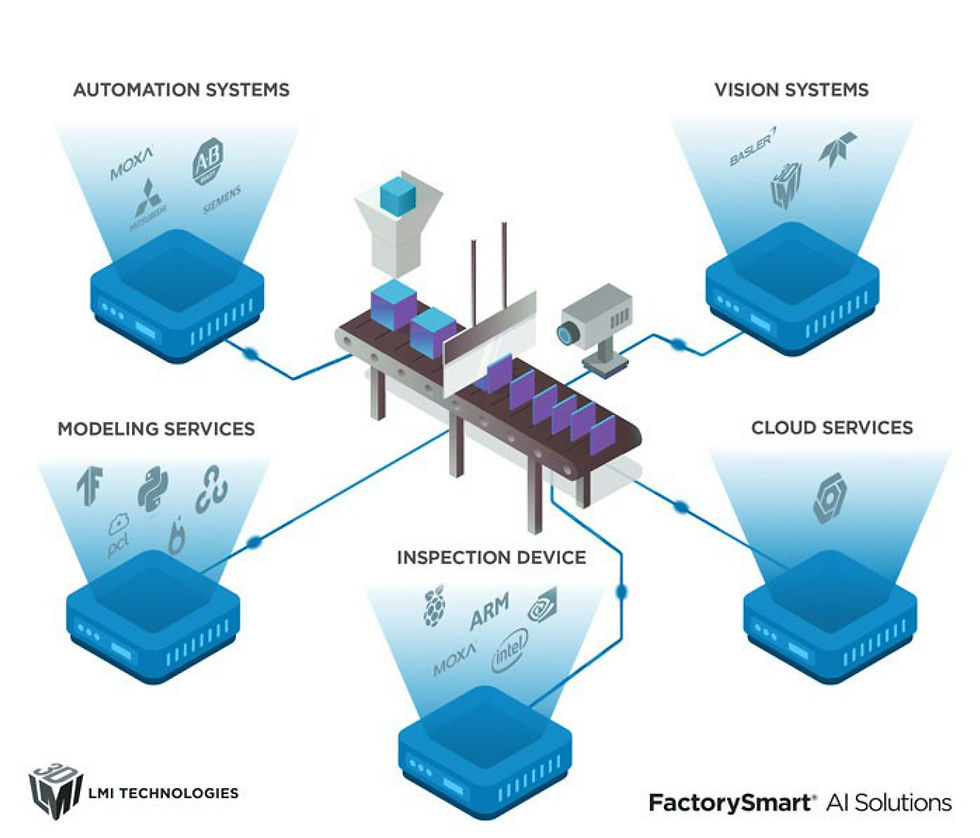
Throughout this factsheet, we discussed the viability of AI for industrial inspection and how LMI can help you determine whether AI is right for your application. We also discussed FactorySmart AI services, the journey of deploying an AI-based production system, and the challenges of maintaining it for years to come.
LMI created the graphic below to help illustrate these elements and the pieces that come together to make AI inspection a reality. We hope this content has helped you on your AI journey, and we look forward to learning about your next inspection challenge!
FactorySmart® AI - Customer Success Story
The Customer | Byrne Electrical |
Factory Site | Rockford, Michigan |
Inspection Challenge |
|
FactorySmart® AI Solution | Application Summary |
Development |
|
Deployment |
 |
Business Result | LMI delivered to Byrne a robust AI inspection system able to locate multiple features and detect known and repeatable part defects with >95% accuracy |


Comments