
Industrial Control Panel Protection: Enclosures, Cooling, and Hardware

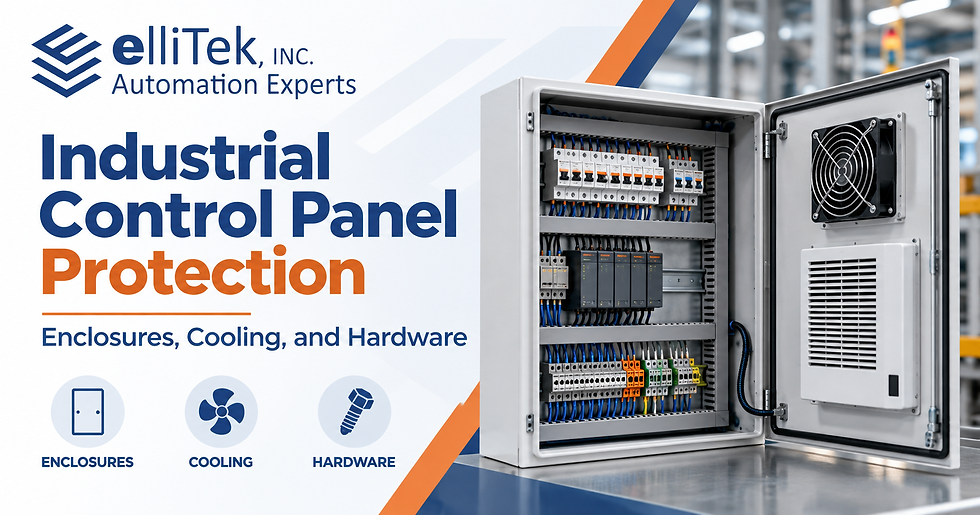
Selecting the controls is only part of planning a reliable panel. Where will the equipment operate? How will heat escape? Can maintenance reach the parts that need service?
Industrial control panel protection combines electrical protective devices, a suitable enclosure, and temperature control. Panel hardware supports the equipment, organizes wiring, and helps make the finished panel easier to maintain. These choices work together, so consider them before finalizing the parts list.
Start with the right kind of protection
Electrical protection and environmental protection address different problems.
Circuit breakers and fuses provide overcurrent protection. Surge protective devices limit brief voltage spikes that could damage connected equipment. These are different functions, not interchangeable solutions.
The enclosure addresses another set of concerns, including access to hazardous parts and exposure to the surrounding environment. Its rating helps identify the conditions it can withstand.
A suitable cabinet does not replace circuit protection. Circuit protection does not replace a suitable cabinet.
How do you choose a control panel enclosure?
Start with the installation environment, not just the cabinet dimensions. Consider dust, moisture, and cleaning methods. Check whether the enclosure material and gasket suit the conditions.
Common NEMA enclosure types offer different protection:
Type 12: Indoor protection against circulating dust, falling dirt, and dripping noncorrosive liquids.
Type 4: Indoor or outdoor protection that includes windblown dust, splashing water, and hose-directed water.
Type 4X: Type 4 protection with added corrosion resistance.
These are starting points for selection, not a substitute for reviewing the full application.
Which cooling method does a control panel need for industrial control panel protection?
Size cooling around the heat released by the installed components, the surrounding temperature, and the equipment’s allowable operating temperatures. Cabinet size alone does not tell you how much cooling you need.
Cooling method | When to consider it | Key limitation |
Filter fans | Outside air is cooler than the required panel temperature, and filtration can adequately control contaminants. | They bring outside air into the enclosure and cannot cool below that air’s temperature. |
Air-to-air heat exchanger | Internal and external air must remain separate, and the outside air is cooler. | Cooling depends on the temperature difference between the two air streams. |
Enclosure air conditioner | The application needs active cooling, including operation below the surrounding air temperature. | Select its capacity and operating range for the actual heat load and environment. |
Do not overlook condensation
Cooling is not the only temperature concern. Cold conditions and temperature changes can create condensation risks. Depending on the application, an enclosure heater with a thermostat or humidity control can help prevent moisture from forming inside the cabinet.
What panel hardware should you include?
Panel hardware includes the parts that support devices, manage wiring, and provide access. Plan these items with the main components:
Mounting and wiring: Mounting plates, DIN rail, and wire duct support an organized layout.
Connections and identification: Terminal blocks, wire markers, and labels help technicians identify circuits.
Access and support: Panel lighting, grounding hardware, and cable-management accessories support installation and service.
Leave room for the required component spacing and maintenance access, not just enough space to close the door.
Cable entries and door hardware also need attention. Use suitable sealing fittings, hole plugs, hinges, and latches. Enclosure-mounted accessories have their own protection ratings; selecting a rated cabinet does not eliminate the need to check them.
Frequently asked questions
Are NEMA and IP ratings interchangeable?
No. They use different requirements. For example, NEMA Type 4X includes corrosion-resistance requirements that an IP rating alone does not establish. Check the ratings required for the installation rather than assuming a direct match.
Can adding a fan affect the enclosure’s protection?
Yes. Review the fan kit’s rating and installation requirements before modifying the cabinet. The same applies to cable fittings, window kits, and other added openings. Confirm that the completed assembly still meets the required protection level.
Plan the panel around the application
Bring your panel layout, component list, and operating conditions. Include any heat, moisture, or access problems your team needs to solve.
elliTek helps manufacturers, OEMs, machine builders, and system integrators select and source enclosure, cooling, protection, and panel components. Qualified engineers and panel builders should review the complete design and installation requirements.
Talk with an elliTek Applications Engineer before you finalize your panel components.

Comments